The Three Masks
Something is breaking in your business right now. And nobody owns it.
Not because your team is bad. Not because nobody cares. Because the system was never designed to catch it.
I've worked with businesses across industries—different products, different markets, different teams. But when operations are breaking, the symptoms are always the same three things. Every time. Without exception.
And here's what makes them so dangerous: they don't look like problems. They look like strengths.
Your organization isn't just tolerating these dysfunctions—it's celebrating them. Putting them in job descriptions. Praising them in performance reviews. Building an identity around them.
That's what makes them so hard to fix. You can't solve a problem you're proud of.
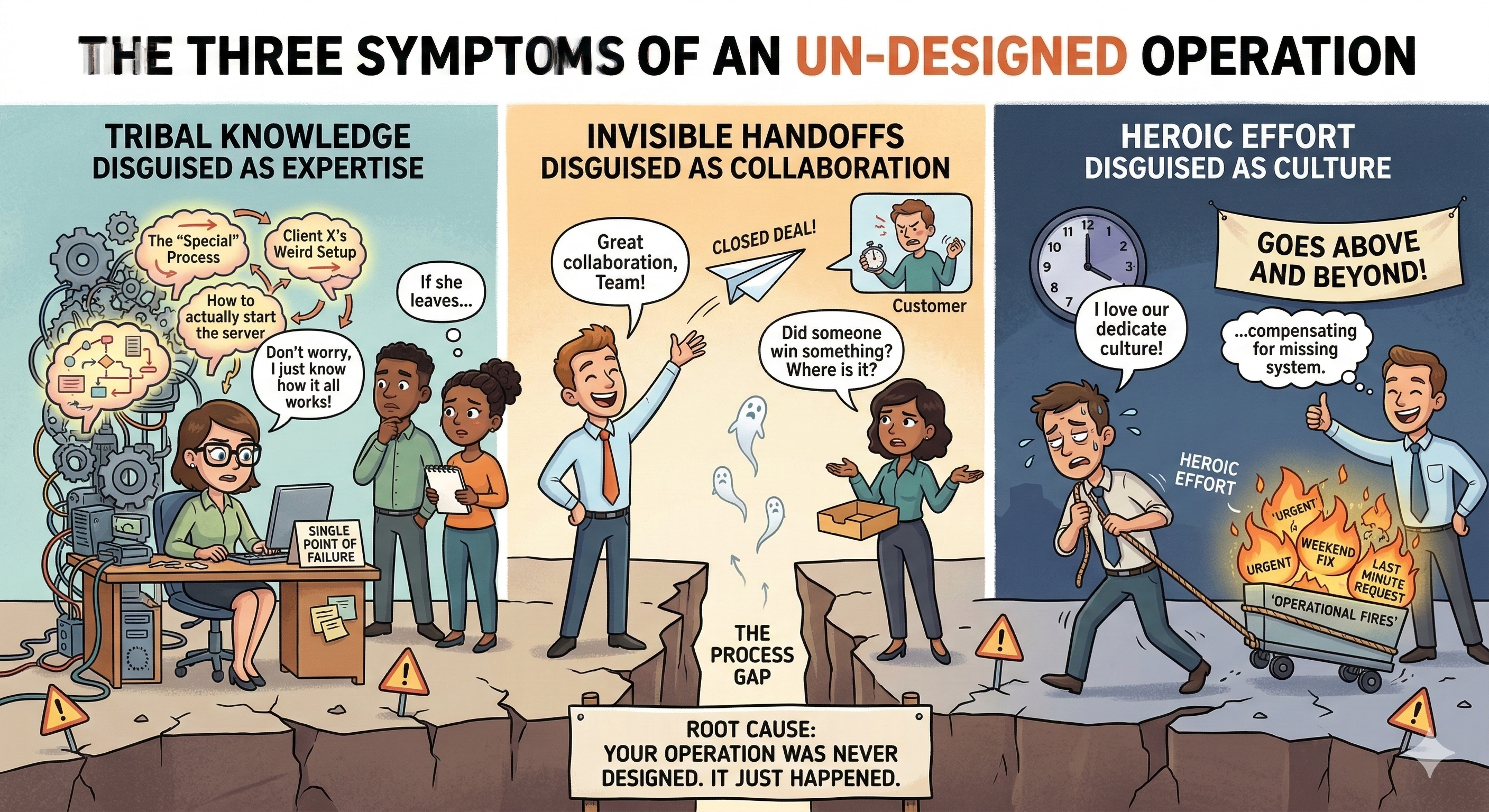
1. Tribal Knowledge Disguised as Expertise
Every department in your company has someone who "just knows how it works."
Sales has the rep who knows the special pricing logic for your top accounts. Operations has the manager who remembers every workaround that keeps fulfillment running. Engineering has the developer who's the only one who understands the integration with your billing system. Customer success has the lead who knows which clients need hand-holding and which ones don't—but has never written any of it down.
Leadership calls these people indispensable. They get praised in all-hands meetings. New hires across every team hear the same advice: "Just ask [name]—they know everything." They're your Cowboys and Surgeons—and you've confused their heroism for a healthy system.
Here's the problem: indispensable is another word for single point of failure. And you don't have one—you have a dozen, scattered across the org.
Want to see how assumptions destroy processes in real time? Try the PBJ Challenge—instruct a literal robot to make a sandwich and watch what happens when "just knows how it works" meets zero assumptions. Takes 3 minutes.
When one of them goes on vacation, their function slows down. When two are out at the same time, things break across departments. When one of them leaves—and at this stage of growth, turnover isn't hypothetical—they take a piece of your operating system with them. Not the software. The actual operating system—the knowledge, the context, the decisions, the workarounds that make their corner of the business function.
That knowledge was never in the business. It was distributed across a handful of people's heads. And when you're trying to scale—to run experiments, test new channels, tighten your funnel, improve retention—every initiative hits the same wall: nobody can describe how the current process actually works well enough to change it.
You might have this problem if:
New hires take months to become productive—not because the role is complex, but because the real process lives in conversations, not documentation.
The same question gets answered differently depending on which team or which person you ask.
You can't run a quick experiment—a new outbound flow, a revised onboarding sequence, a pricing test—without first spending weeks extracting how the current process works from the people running it.
Every attempt to improve a stage of your customer journey stalls because "that depends" is the answer to every question—and the thing it depends on is individual judgment, not a documented standard.
This isn't a people problem. It's a systems problem—and a culture problem. And those two things have fused together in a way that makes it genuinely hard to untangle.
Because this didn't happen overnight. It crept in. One undocumented workaround at a time, one "just ask [name]" at a time, until tribal knowledge stopped being a gap and became the way things are done here. It got absorbed into onboarding. Reinforced in meetings. Celebrated in performance reviews. It became part of the culture.
And once something is accepted as culture, people don't just tolerate it—they defend it. They're proud of it. They've built their professional identity around being the person who knows. Telling them the system needs to change feels like telling them they need to change. Which means fixing this requires both a sledgehammer and surgical precision—the force to break through the cultural resistance, and the care to not destroy the expertise that's actually valuable in the process.
Expertise distributed across a dozen people's heads isn't institutional knowledge. It's a dozen resignation letters away from operational collapse.
I've written about this pattern extensively—it's one of the defining features of what I call Accidental Hell: when you become the operating system instead of having one. If this symptom hit close to home, that article will hit closer.
2. Invisible Handoffs Disguised as Collaboration
Marketing generates a qualified lead. Sales closes the deal. Then what?
An account manager sends a welcome email. Someone in ops creates a record in the CRM—or maybe two people do, in two different systems. A project lead checks a shared spreadsheet to see if onboarding should start. Customer success doesn't find out for three days. The customer waits a week before anyone with context actually reaches out.
Nobody dropped the ball. That's the thing. There was no ball to drop—just a gap between teams that everyone assumed someone else was covering.
From the inside, this looks like collaboration. Teams working together. People pitching in. Cross-functional teamwork.
From the outside—from your customer's perspective—it looks like confusion. Delay. Silence. The uncomfortable feeling that nobody is in charge of what happens next.
The anatomy of an invisible handoff:
One team completes their stage. Sales closes. Marketing hands off the lead. The project wraps. Their part is done.
The next team hasn't started. Onboarding doesn't know it's their turn. Customer success wasn't looped in. The transition between Activation and Engagement—the moment where a new customer becomes an active one—has no owner.
The gap in between? Nobody owns it. There's no trigger. No notification. No defined moment where responsibility transfers from one function to another.
The customer sits in that gap. Waiting. Wondering. Losing confidence with every silent day. And you can't even measure the damage—because the gap isn't in anyone's dashboard.
You call it teamwork. I call it a gap nobody bothered to design.
This isn't a niche problem. McKinsey's operations research calls bad handoffs "a perpetual problem" in service organizations—driven by the complexity of coordinating multiple functions in nonlinear ways. Most companies don't even have the transparency to see where work breaks down between teams, let alone fix it.
And your organization is full of them. Between marketing and sales. Between sales and onboarding. Between onboarding and delivery. Between delivery and retention. Between a support ticket and its resolution. Every transition point where work moves from one team, function, or stage to another—that's where invisible handoffs live. And when you try to run an experiment—a new outbound sequence, a revised activation flow, a retention campaign—it stalls, because the handoff before it and the handoff after it were never designed in the first place.
The worst part? Nobody feels responsible for the failure because nobody was assigned the transition. The handoff itself was never part of anyone's job. It was assumed.
The most dangerous moment in any process isn't when someone makes a mistake. It's when work changes hands and nobody notices.
If this one resonates, you'll want to read Where Your Customer Experience Breaks—a stage-by-stage diagnostic using the AAAERRR framework that helps you find exactly where your handoffs are failing and what they're costing you.
3. Heroic Effort Disguised as Culture
Late nights. Weekend Slack messages. The "whatever it takes" energy that leadership loves to celebrate.
"We just have a team that goes above and beyond."
No. You have a team compensating for a system that doesn't exist.
There's a meaningful difference between dedication and desperation. Dedication is choosing to go the extra mile because you care about the outcome. Desperation is going the extra mile because the system requires it—because if you don't, things fall apart.
From the outside, they look identical. The same late hours. The same weekend messages. The same exhaustion on Monday morning.
But the cause is completely different. And the outcome is, too.
Dedication is sustainable. It comes from purpose. Desperation is a countdown. It comes from gaps that should be filled by design, not by someone's willingness to sacrifice their evening.
Harvard Business Review has been sounding this alarm for years. Eric Garton's research found that burnout costs an estimated $125 to $190 billion a year in US healthcare spending alone—and the true cost to business is far greater through lost productivity, high turnover, and the loss of your most capable people. Burnout researchers Leiter and Maslach put it more bluntly in HBR: burned-out employees are canaries in the coal mine. When the canary keels over, you acknowledge the environment is hazardous—you don't tell the canary to take a long weekend.
Burnout isn't a personal resilience issue. It's a systems design issue. And if your response to it is wellness apps and pizza parties instead of fixing the operation that's causing it, you're treating a symptom while feeding the disease.
The countdown looks like this:
First, your best people stop suggesting improvements. They used to have ideas. Now they just try to survive the week.
Then, the quiet ones leave. Not with drama—with a two-week notice and a polite exit interview that says "looking for new challenges." What they mean is: I'm tired of holding everything together.
Then, the ones who stay get brittle. Shorter tempers. More sick days. Less patience for new hires who don't "get it" fast enough.
Finally, a customer churns and nobody can explain why. Because nobody saw the slow erosion happening. They were too busy being heroic.
The cruelest part? The people doing the heroic work often can't see it for what it is. They've been praised for it. Promoted for it. Given awards for it. Their identity is wrapped up in being the person who makes things work.
Telling them the system is broken feels like telling them their effort doesn't matter. That's not the message. Their effort is extraordinary. It's the need for that effort that's the problem.
Culture should be what people experience when the system is working. Not what people produce when the system isn't.
I wrote an entire piece about this dynamic—how the fires keep coming back, why the craftsperson keeps getting pulled into them, and what the alternative actually looks like. If this is hitting close, read The Fire That Won't Stay Out.
Three Symptoms. One Root Cause.
These three things aren't separate problems. They're the same problem wearing different masks.
And they share something else: they've all been absorbed into the culture. Tribal knowledge is "expertise." Invisible handoffs are "collaboration." Heroic effort is "dedication." The organization doesn't just tolerate these patterns—it rewards them. Which is why they're so persistent. You're not fighting a broken system. You're fighting an identity that formed around the brokenness.
Your operation was never designed. There's a design layer between strategy and execution—and in most businesses, it's empty. So the operation emerged.
One workaround at a time. One "we'll fix it later" at a time. One team absorbing complexity that should live in the system, not in their institutional memory. Until what you're running isn't an operation—it's an accumulation of survival decisions spread across every department.
And here's the part that stings: it worked. For a while. Maybe for a long while. You grew. You hired. You crossed a million in revenue. You landed bigger clients. You built something real.
But the thing that got you here will not get you there.
Because every one of those survival decisions is still in the system. Every workaround is still running. Every assumption is still being relied on. And as the organization gets bigger—more customers, more team members, more handoffs, more surface area—the gaps don't shrink. They multiply. And they get harder to see, because now they're buried under layers of process that grew on top of them.
The cost isn't abstract. McKinsey estimates that 20–30% of operating expenses in the average company are lost to inefficiency—rework, miscommunication, duplicated effort, and decisions that stall because nobody has enough visibility to make them. That's not a rounding error. For a company doing $3 million in revenue, that's $600K–$900K a year evaporating into gaps that were never designed out of the system.
You can't scale what you can't see. You can't improve what you haven't mapped. And you can't fix a system that was never built.
This is the foundational premise of Deliberate Work: the difference between businesses that grow with intention and businesses that grow by accident isn't talent, technology, or luck. It's whether the operation was designed—or whether it just happened.
So What Do You Do About It?
The instinct is to jump to solutions. Adopt a tool. Hire a person. Implement a new process. Write some SOPs. Maybe throw AI at it—without first answering the one question that determines whether AI will help or hurt.
Resist that instinct.
Because every one of those "solutions" assumes you understand the problem. And if you did, you wouldn't have these three symptoms across your organization in the first place.
The first step—the only step that matters right now—is understanding the work as it actually happens. Not how you think it happens. Not how it's supposed to happen. Not how the employee handbook says it happens.
How it actually happens. Today. Across every team. In reality.
That means mapping your real flows: who does what, in what order, with what information, triggered by what event, handed off to which team, and checked by what standard. From the moment a prospect becomes aware of you through the moment a customer refers someone else. Every stage. Every transition. Every decision point.
When you do this—genuinely, honestly, with every function in the room—three things will happen:
The tribal knowledge becomes visible. You'll see exactly which steps depend on specific people's judgment versus documented standards. You'll know what to extract, document, and systematize—and what should rightfully remain a human decision.
The invisible handoffs become obvious. You'll see every gap between teams. Every place where work sits in limbo between functions. Every transition that depends on someone remembering to check rather than being triggered by design.
The heroic effort reveals its true cost. You'll see where people are compensating—and you'll finally be able to design the system they deserve to work within instead of the one they've been propping up.
And once things are named—once the stages are visible, the handoffs are documented, the gaps are identified—something powerful becomes possible: you can run experiments. Quick, discrete, targeted experiments. Test a new outbound flow. Redesign the activation sequence. Tighten the handoff between sales and onboarding. Measure whether it worked. Iterate.
You can't experiment on what you can't name. And you can't name what you haven't mapped.
Understanding the work is the prerequisite to fixing the work. Everything else is guessing with a budget.
If you want a practical framework for doing this mapping across your entire customer journey, start with the AAAERRR framework—a shared vocabulary for the seven stages every customer moves through, whether you've designed them or not. Then use the diagnostic to find your constraint.
And if you want to understand the deeper philosophy behind why this matters—why design beats reaction, why the craftsperson must also become the architect, why the goal isn't to eliminate the human from the work but to free the human for the work that matters most—that's what Deliberate Work is about.
The Choice
You have two options.
You can keep running on tribal knowledge, invisible handoffs, and heroic effort. It'll work. It has worked. For now.
Or you can decide that the operation your team deserves—the one your customers deserve—needs to be designed. On purpose. With intention.
Not all at once. Not perfectly. Just deliberately.
One step at a time. Starting with the mess of today—because that's the only honest place to begin.
If you read this and someone's face came to mind—that's not the problem. They're the symptom. The missing system is the problem. And that's something you can build.
Go Deeper
- On the root cause beneath the three symptoms: Minock, J. (2026). "The Fifth Kind of Debt Your Business Is Carrying." Deliberate Work. Tribal knowledge, invisible handoffs, and heroic effort are symptoms of Operation Debt—the cost of work that was never specified.
- On tribal knowledge and the accidental operating system: Minock, J. (2025). "From Accidental Hell to Deliberate Happiness." Deliberate Work. What happens when you become the system—and how to escape.
- On invisible handoffs and where the experience breaks: Minock, J. (2026). "Where Your Customer Experience Breaks (And How to Fix It)." Deliberate Work. A stage-by-stage diagnostic to find exactly where work disappears.
- On heroic effort and the fires that never stop: Minock, J. (2025). "The Fire That Won't Stay Out." Deliberate Work. Why the same fires keep coming back—and how to stop being the firefighter.
- On the shared vocabulary for diagnosing your operation: Minock, J. (2026). "The AAAERRR Framework, Complete: Three Zones, Seven Stages, One Language." Deliberate Work. The AAAERRR framework.
- On the craftsperson's role in building the system: Minock, J. (2025). "The Craftsperson vs. Business Person Paradox." Deliberate Work. Why being great at the work isn't enough to build a great business.
External Research
- On burnout as a company problem: Garton, E. (2017). "Employee Burnout Is a Problem with the Company, Not the Person." Harvard Business Review. The case that burnout is an organizational design failure, not a personal resilience issue.
- On designing jobs to prevent burnout: Leiter, M. P. & Maslach, C. (2023). "To Curb Burnout, Design Jobs to Better Match Employees' Needs." Harvard Business Review. Burnout as a response to chronic job stressors embedded in workplace practices—not a wellness problem.
- On collaboration overload and what's really fueling burnout: Cross, R. & Dillon, K. (2023). "What's Fueling Burnout in Your Organization?" Harvard Business Review. Research showing burnout is driven by excessive collaboration demands between individuals and teams—not just workload volume.
- On operational transparency and the handoff problem: McKinsey & Company. (2022). "How Good Are Your Internal Operations—Really?" Why bad handoffs are a perpetual problem in service organizations, and why most companies lack the visibility to diagnose them.
- On the cost of operational inefficiency: McKinsey & Company. (2024). "Have You Fully Cracked the Efficiency Code?" Research showing 20–30% of operating expenses are lost to rework, miscommunication, and undesigned processes.
TL;DR
Every broken operation has the same three symptoms—tribal knowledge disguised as expertise, invisible handoffs disguised as collaboration, and heroic effort disguised as culture. They share one root cause: the operation was never designed. And they persist because the organization has built its identity around them. The fix starts with mapping reality—how work actually flows today—then designing from there.
Henry applies this framework in practice. Try it at okhenry.ai.